Invisible Influence, Hidden Worlds An Interview with Hanbyul Oh
by LED.ART EDITORIAL
Invisible Influence, Hidden Worlds
An Interview with Hanbyul Oh
by LED.ART EDITORIAL
As AI and digital technologies move beyond transforming how images are created and begin reshaping the structures of thought and relationships themselves, artist Hanbyul Oh approaches technology not merely as a tool, but as a medium for reflection. His work visualizes invisible emotions, subtle influences, and the possibility of hidden worlds embedded within everyday life.
From the Red Dot Design Award–winning project Influence to media art, brand content, and exhibition-based works, his practice continually questions how digital images can expand beyond the screen—becoming part of spatial and environmental experience.
In this interview, we explore the conceptual origins and production process of Influence, his creative workflow combining AI and 3D technologies, and the evolving universe of Mini Republic. Moving between technology and sensibility, concept and experience, the conversation traces the quiet yet deliberate trajectory of his artistic thinking.
Q1. Please introduce yourself. Could you share your creative journey and current areas of focus?
A. Hello, my name is Hanbyul Oh. I am a media artist working primarily with AI and digital technologies, focusing on video and media-based projects. I run an AI-driven video production studio while simultaneously engaging in brand content, media art projects, and exhibition work. Alongside this, I continue research and educational activities centered on digital imagery and visual culture.
Currently, my work revolves around a world-building project titled Mini Republic. It begins with the imagination that another world might exist within ordinary spaces or objects. By combining a miniature-scale perspective with digital media, I explore hidden narratives embedded in everyday environments.
In parallel, I am hosting an AI video podcast that archives conversations with artists who work with AI or integrate AI elements into their existing practices. Through this project, I aim to document dialogues with artists navigating creative expression in the age of AI.
Q2. What led you to submit Influence to the Red Dot Design Award?
A. Influence was conceived as part of an industry–academic collaboration between Hongik University’s Graduate School of Visual Communication Design and d’strict. After the project was completed, Professor Jiyoon Kim, who supervised the work, suggested submitting it to the Red Dot Design Award. I felt that the theme could resonate within an international context of design and communication, which ultimately led to the submission.
Q3. How did the theme Influence originate? Could you share the background and social context behind the project?
A. Influence began as a reflection on how we continuously affect one another in an era saturated with influencers. While we are clearly shaped by well-known figures, I wanted to focus on the influence exchanged through everyday interactions—between coworkers, classmates, friends, and even strangers walking the same path.
We are constantly influenced in subtle ways: through clothing, facial expressions, gestures, and movement. These intangible exchanges often go unnoticed. The project started from a desire to visualize this invisible form of influence.
INFLUENCE by Hanbyul Oh
Q4. Could you walk us through your production process? From concept to execution, what tools and technologies were involved?
A.Rather than focusing on major events, I wanted to express the quiet, continuous exchanges of influence that occur in daily life. This led to the setting of people walking together. As the leading figure emits colorful smoke and particles, those following pass through and are affected by these elements.
During the conceptual phase, I primarily used the AI tool Midjourney to establish key visuals, aiming to integrate AI as much as possible. While I initially hoped to generate walking motion, smoke, and particles entirely through AI, the project began in September 2024, when AI video technology was still limited.
As a result, I transitioned to a 3D-based workflow. Walking simulations were generated using Mixamo, while smoke simulations were created in Embergen, a real-time VFX simulation tool. These simulations were imported into Blender, where shading, coloring, and particle animations were added. Multiple layers of smoke and particle effects were built to enhance realism, followed by color grading in DaVinci Resolve. The background music was generated using SumoAI, tailored to match the motion and rhythm of the visuals.
Q5. Which expressive elements were most important to you during production?
A.I placed the greatest emphasis on visual composition. To convey the intangible concept of influence, smoke and particle simulations were central to the work. I also incorporated interaction within the piece—figures collide with, react to, and disperse the smoke and particles, suggesting invisible relationships among unseen individuals.
reddot winner 2025
Q6. What distinguishes this project from your previous work?
A.Where does Influence sit within your creative trajectory?
Influence marked a shift toward translating abstract concepts into visual language. It was an experiment in whether a message could be conveyed without narrative or characters.
By transforming the invisible flow of emotion and relationships into physical elements like smoke and particles, the project became a turning point for my practice. While my earlier works leaned heavily on storytelling, this experience opened the possibility of concept-driven media art. Since then, I have become increasingly focused on conveying ideas through intuitive sensory experiences.
Q7. How did your collaboration with LED.ART influence your perspective?
A.Collaborating with LED.ART allowed me to experience how digital images can evolve beyond the screen and become part of a spatial environment. When the work was presented on large-scale LED displays, viewers were no longer merely observers—they became immersed within the scene itself.
This experience highlighted the potential of media art to shift from passive viewing to embodied experience. It became a key turning point that deepened my interest in spatial media art, leading me to continue pursuing offline exhibitions.
SAPPHIRE PROJECT, 2025
Q8. Are there any current or upcoming projects you would like to share?
A. I am currently expanding the Mini Republic universe through various media art and video projects. The premise imagines miniature civilizations existing within everyday objects and spaces, extending into short-form videos, brand content, exhibitions, and interactive installations. Ultimately, I aim to develop this world as a cultural IP.
In parallel, I continue brand collaborations using AI-based video production techniques, navigating the boundary between commercial work and artistic practice.
Another major initiative is an upcoming AI video podcast. This platform invites experts in AI, digital content, and media art to explore where technology and creativity intersect. The goal is to move beyond information-sharing and toward deeper inquiry into emerging creative methodologies and visual culture. The series is scheduled to launch in late January under the title Han’s AI Podcast.
Q9. What trends or possibilities are you currently observing in digital design and media art?
A.One of the most significant shifts is AI’s emergence as a creative partner rather than just a production tool. Image, video, sound, and narrative generation are becoming integrated into unified pipelines, dramatically accelerating the translation of imagination into form.
I am also intrigued by how digital design and media art increasingly intersect with urban space, public media, and brand experiences. Screens are no longer merely devices—they are becoming urban landscapes and stages. Within this evolution, media art has the potential to become a more accessible and widely understood visual language.
Q10. What directions would you like to explore moving forward?
A. I hope to further explore the point at which imagined worlds intersect with real spaces. Whether through large urban screens, exhibitions, or public environments, I want to create encounters where viewers unexpectedly discover another world hidden within familiar settings.
My goal is to develop Mini Republic into a lasting cultural IP and to continue creating work that shifts how people perceive ordinary spaces. Ultimately, I aim to remind viewers that the world we pass through so casually may be far stranger and more fascinating than it appears.
Hanbyul Oh’s reflections do not simply speak of technological advancement, but of how technology reshapes the way we see the world and relate to one another. From Influence to the expanding universe of Mini Republic, his work opens a quiet yet profound imagination—one where unseen narratives may exist within the most familiar spaces. Even as AI accelerates the pace of creation, his practice preserves moments of pause—leaving space for thought, perception, and resonance. LED.ART will continue to document and support these moments as they extend beyond digital images into lived, spatial experience.


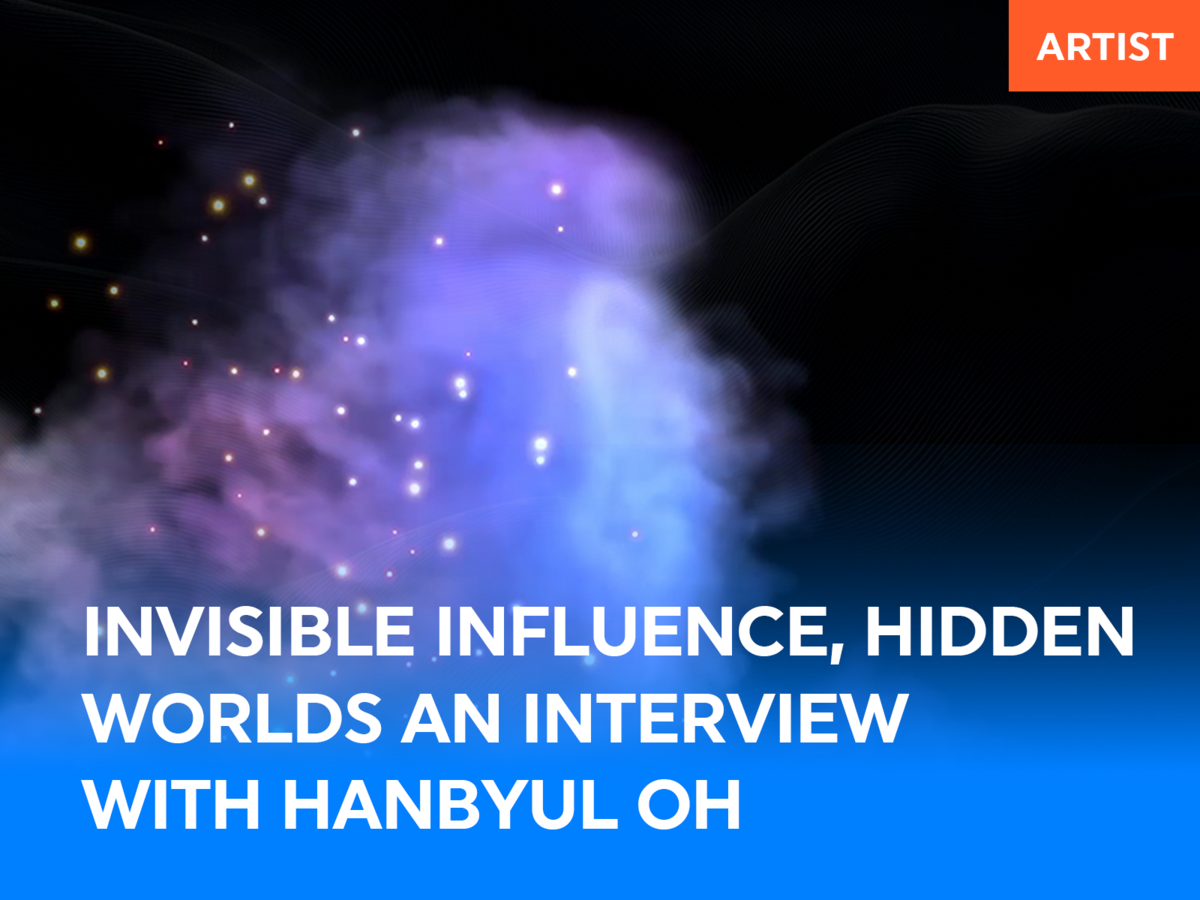

Invisible Influence, Hidden Worlds An Interview with Hanbyul Oh
by LED.ART EDITORIAL
As AI and digital technologies move beyond transforming how images are created and begin reshaping the structures of thought and relationships themselves, artist Hanbyul Oh approaches technology not merely as a tool, but as a medium for reflection. His work visualizes invisible emotions, subtle influences, and the possibility of hidden worlds embedded within everyday life.
From the Red Dot Design Award–winning project Influence to media art, brand content, and exhibition-based works, his practice continually questions how digital images can expand beyond the screen—becoming part of spatial and environmental experience.
In this interview, we explore the conceptual origins and production process of Influence, his creative workflow combining AI and 3D technologies, and the evolving universe of Mini Republic. Moving between technology and sensibility, concept and experience, the conversation traces the quiet yet deliberate trajectory of his artistic thinking.
Q1. Please introduce yourself. Could you share your creative journey and current areas of focus?
A. Hello, my name is Hanbyul Oh. I am a media artist working primarily with AI and digital technologies, focusing on video and media-based projects. I run an AI-driven video production studio while simultaneously engaging in brand content, media art projects, and exhibition work. Alongside this, I continue research and educational activities centered on digital imagery and visual culture.
Currently, my work revolves around a world-building project titled Mini Republic. It begins with the imagination that another world might exist within ordinary spaces or objects. By combining a miniature-scale perspective with digital media, I explore hidden narratives embedded in everyday environments.
In parallel, I am hosting an AI video podcast that archives conversations with artists who work with AI or integrate AI elements into their existing practices. Through this project, I aim to document dialogues with artists navigating creative expression in the age of AI.
Q2. What led you to submit Influence to the Red Dot Design Award?
A. Influence was conceived as part of an industry–academic collaboration between Hongik University’s Graduate School of Visual Communication Design and d’strict. After the project was completed, Professor Jiyoon Kim, who supervised the work, suggested submitting it to the Red Dot Design Award. I felt that the theme could resonate within an international context of design and communication, which ultimately led to the submission.
Q3. How did the theme Influence originate? Could you share the background and social context behind the project?
A. Influence began as a reflection on how we continuously affect one another in an era saturated with influencers. While we are clearly shaped by well-known figures, I wanted to focus on the influence exchanged through everyday interactions—between coworkers, classmates, friends, and even strangers walking the same path.
We are constantly influenced in subtle ways: through clothing, facial expressions, gestures, and movement. These intangible exchanges often go unnoticed. The project started from a desire to visualize this invisible form of influence.
INFLUENCE by Hanbyul Oh
Q4. Could you walk us through your production process? From concept to execution, what tools and technologies were involved?
A. Rather than focusing on major events, I wanted to express the quiet, continuous exchanges of influence that occur in daily life. This led to the setting of people walking together. As the leading figure emits colorful smoke and particles, those following pass through and are affected by these elements.
During the conceptual phase, I primarily used the AI tool Midjourney to establish key visuals, aiming to integrate AI as much as possible. While I initially hoped to generate walking motion, smoke, and particles entirely through AI, the project began in September 2024, when AI video technology was still limited.
As a result, I transitioned to a 3D-based workflow. Walking simulations were generated using Mixamo, while smoke simulations were created in Embergen, a real-time VFX simulation tool. These simulations were imported into Blender, where shading, coloring, and particle animations were added. Multiple layers of smoke and particle effects were built to enhance realism, followed by color grading in DaVinci Resolve. The background music was generated using SumoAI, tailored to match the motion and rhythm of the visuals.
Q5. Which expressive elements were most important to you during production?
A. I placed the greatest emphasis on visual composition. To convey the intangible concept of influence, smoke and particle simulations were central to the work. I also incorporated interaction within the piece—figures collide with, react to, and disperse the smoke and particles, suggesting invisible relationships among unseen individuals.
reddot winner 2025
Q6. What distinguishes this project from your previous work?
A. Where does Influence sit within your creative trajectory?
Influence marked a shift toward translating abstract concepts into visual language. It was an experiment in whether a message could be conveyed without narrative or characters.
By transforming the invisible flow of emotion and relationships into physical elements like smoke and particles, the project became a turning point for my practice. While my earlier works leaned heavily on storytelling, this experience opened the possibility of concept-driven media art. Since then, I have become increasingly focused on conveying ideas through intuitive sensory experiences.
Q7. How did your collaboration with LED.ART influence your perspective?
A. Collaborating with LED.ART allowed me to experience how digital images can evolve beyond the screen and become part of a spatial environment. When the work was presented on large-scale LED displays, viewers were no longer merely observers—they became immersed within the scene itself.
This experience highlighted the potential of media art to shift from passive viewing to embodied experience. It became a key turning point that deepened my interest in spatial media art, leading me to continue pursuing offline exhibitions.
SAPPHIRE PROJECT, 2025
Q8. Are there any current or upcoming projects you would like to share?
A. I am currently expanding the Mini Republic universe through various media art and video projects. The premise imagines miniature civilizations existing within everyday objects and spaces, extending into short-form videos, brand content, exhibitions, and interactive installations. Ultimately, I aim to develop this world as a cultural IP.
In parallel, I continue brand collaborations using AI-based video production techniques, navigating the boundary between commercial work and artistic practice.
Another major initiative is an upcoming AI video podcast. This platform invites experts in AI, digital content, and media art to explore where technology and creativity intersect. The goal is to move beyond information-sharing and toward deeper inquiry into emerging creative methodologies and visual culture. The series is scheduled to launch in late January under the title Han’s AI Podcast.
Q9. What trends or possibilities are you currently observing in digital design and media art?
A. One of the most significant shifts is AI’s emergence as a creative partner rather than just a production tool. Image, video, sound, and narrative generation are becoming integrated into unified pipelines, dramatically accelerating the translation of imagination into form.
I am also intrigued by how digital design and media art increasingly intersect with urban space, public media, and brand experiences. Screens are no longer merely devices—they are becoming urban landscapes and stages. Within this evolution, media art has the potential to become a more accessible and widely understood visual language.
Q10. What directions would you like to explore moving forward?
A. I hope to further explore the point at which imagined worlds intersect with real spaces. Whether through large urban screens, exhibitions, or public environments, I want to create encounters where viewers unexpectedly discover another world hidden within familiar settings.
My goal is to develop Mini Republic into a lasting cultural IP and to continue creating work that shifts how people perceive ordinary spaces. Ultimately, I aim to remind viewers that the world we pass through so casually may be far stranger and more fascinating than it appears.
Hanbyul Oh’s reflections do not simply speak of technological advancement, but of how technology reshapes the way we see the world and relate to one another. From Influence to the expanding universe of Mini Republic, his work opens a quiet yet profound imagination—one where unseen narratives may exist within the most familiar spaces. Even as AI accelerates the pace of creation, his practice preserves moments of pause—leaving space for thought, perception, and resonance. LED.ART will continue to document and support these moments as they extend beyond digital images into lived, spatial experience.