Screen, City, and the Rhythm of the Audience
by L. J. KIM, Director at d'strict
Urban screens have evolved into media environments that embed unfamiliar temporalities into the everyday and compose new rhythms in our lives. The vision of a ‘traveling metropolis,’ an imagined future of mobile urbanism, proposed in 🔗Archigram’s Instant City project of the 1960s and ’70s has become reality in many ways. From Times Square in New York to Piccadilly Circus in London, and Samseong Station in Seoul, the screen has become more than a transmitter of visual content. It now orchestrates flows of perception, generating sensorial rhythms through the gathering and movement of people at the heart of the city.
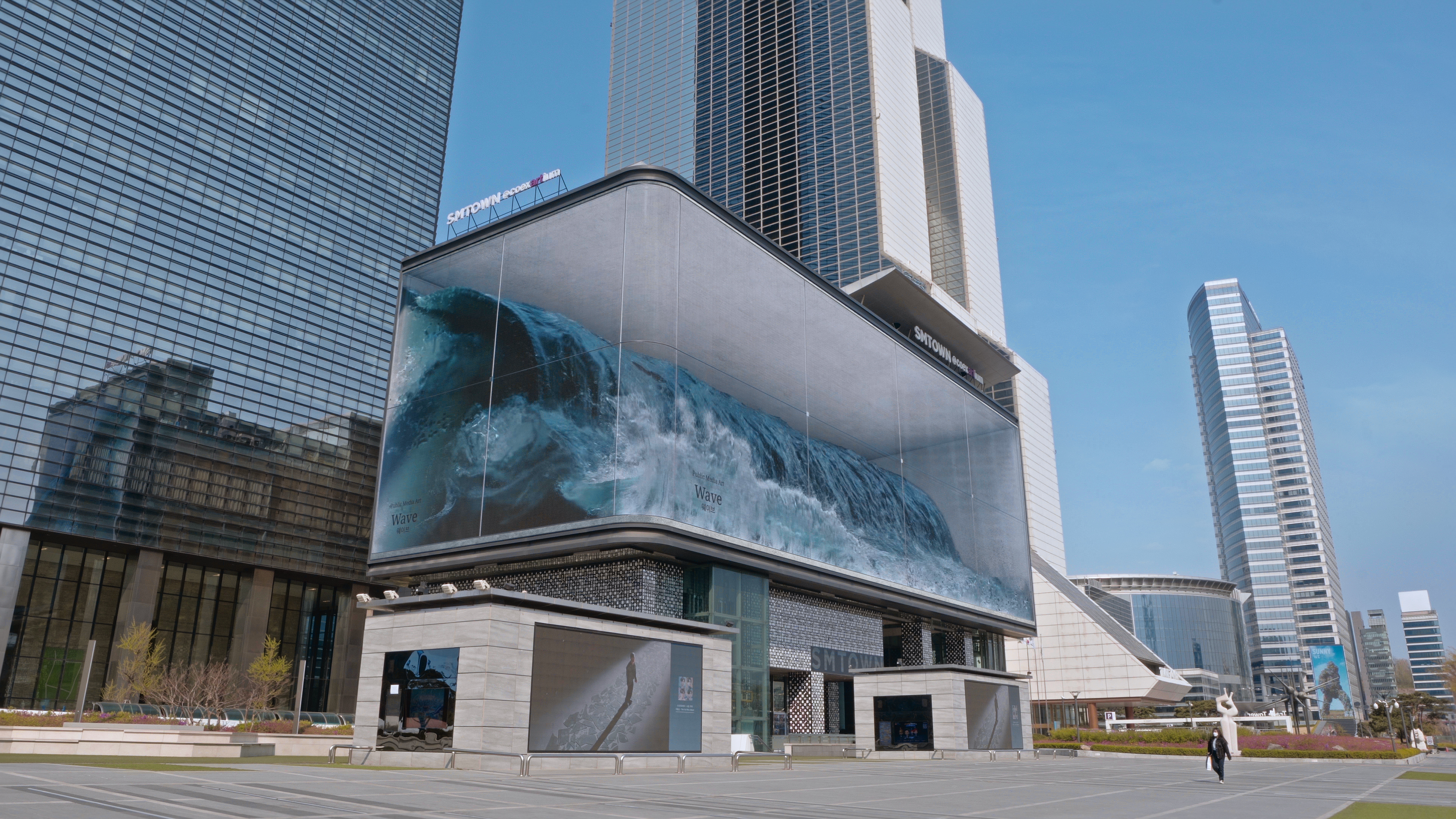
WAVE by d'strict
Urban Screen, Inhabited by Art
This expanded screen has offered fertile ground for creative inquiry. Since the early 2000s, artists and collectives have continuously reimagined screens not as passive commercial surfaces but as potential public art platforms. Projects ranging from open-source laser graffiti to architectural-scale LED installations have opened new modes of engagement with urban media.
In 2006, Graffiti Research Lab’s 🔗L.A.S.E.R Tag projected ephemeral drawings across cities in the United States using open-source technology. In 2008, Medialab Prado in Madrid unveiled a 14.5-by-9.4-meter 🔗 LED media façade dedicated specifically to artistic use. Since 2012, 🔗Midnight Moment has illuminated more than 90 screens in New York’s Times Square each night, from 11:57 pm to midnight. In 2020, 🔗CIRCA launched as a global art platform, expanding this model to major cities through iconic digital billboards, beginning with London’s Piccadilly Circus. That same year, d’strict’s 🔗 Wave garnered global attention by reimagining a commercial media screen as immersive public art. These examples signal a continuing evolution in how the screen is inhabited, reimagined, and redefined.
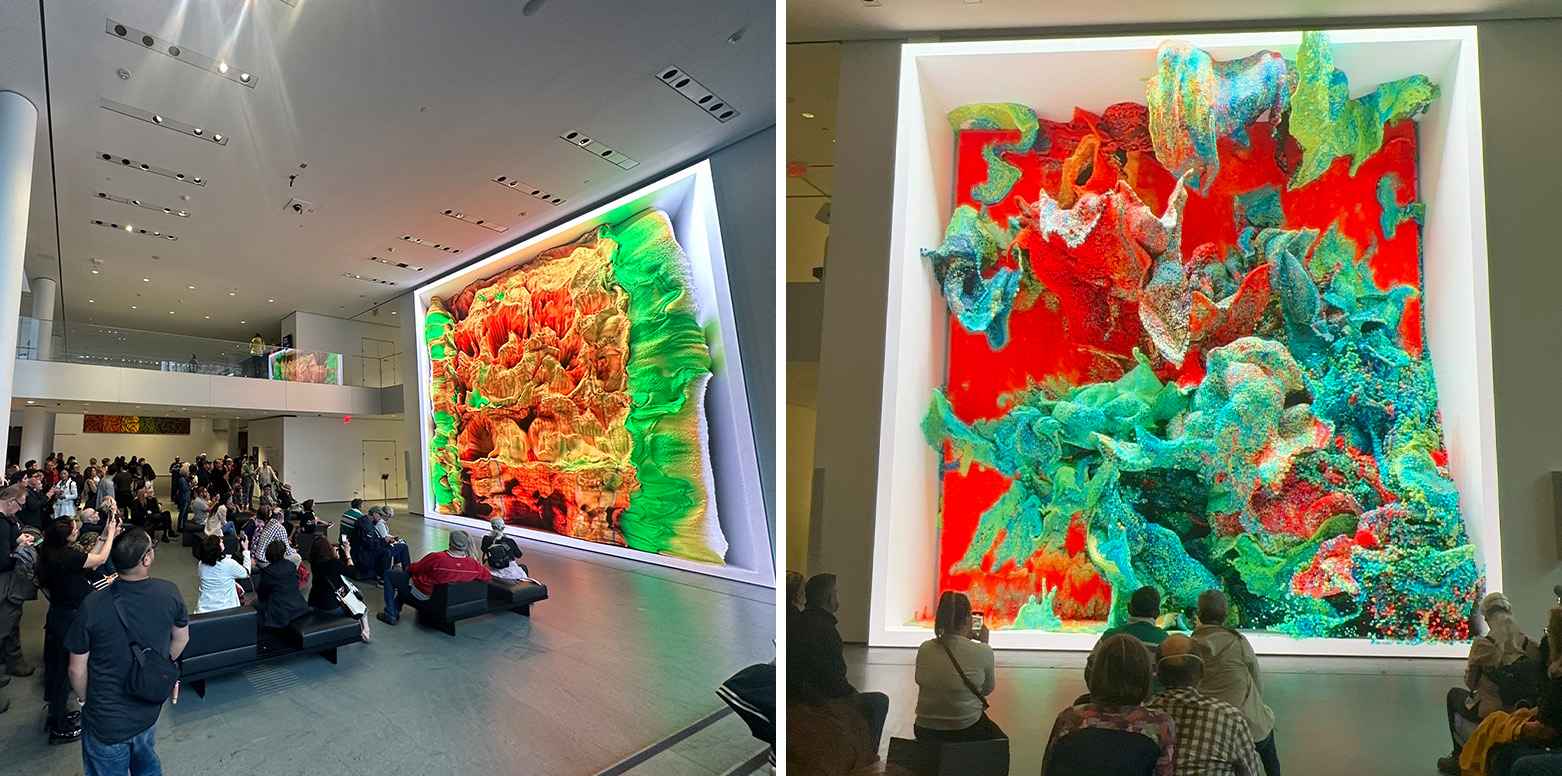
Unsupervised by Epik Anadol @MoMA
Screen, Enters the Museum
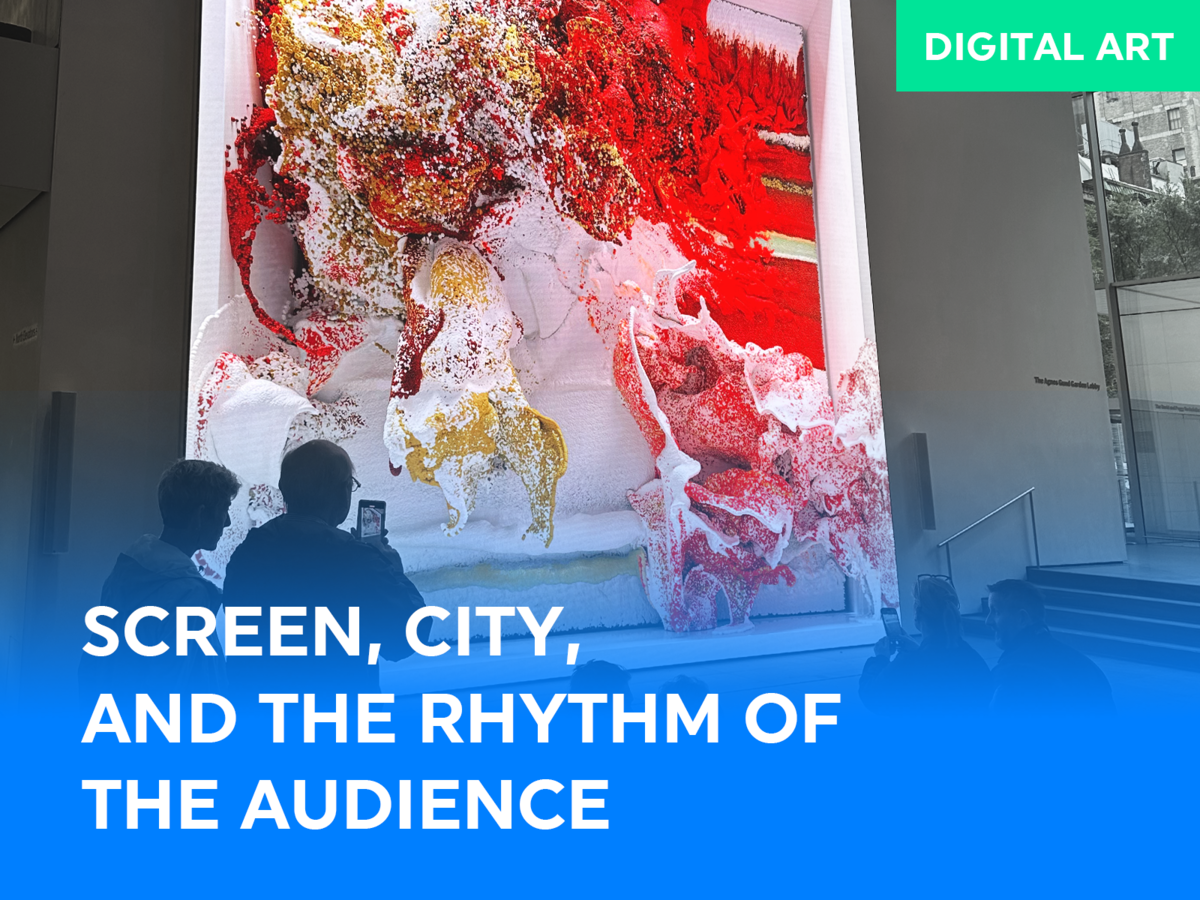
The screen has also entered institutional space, suggesting another vector of expansion. A pivotal example is 🔗Unsupervised by Refik Anadol, presented at The Museum of Modern Art (MoMA) in New York in 2022. Generated by an AI trained on more than 200 years of MoMA’s collection data and integrated with real-time, site-specific input, the work functions as an evolving, immersive installation. The result is a high-resolution screen, measuring 7.21 by 7.44 meters, that dominates the museum’s main lobby both visually and spatially. Beyond its technical feat, Unsupervised drew attention both from general audiences and from members of the established art community, raising questions about the place of digital media within the canon. Visitors danced, shifted their posture, and gathered in groups, as documented on 🔗 Anadol’s Instagram. Such spontaneous engagement was rarely observed before in exhibitions of painting or sculpture. The work demonstrated that the screen functions not merely as a display but as a spatial interface: a sensorial field that generates rhythm and reciprocal presence between art and audience.
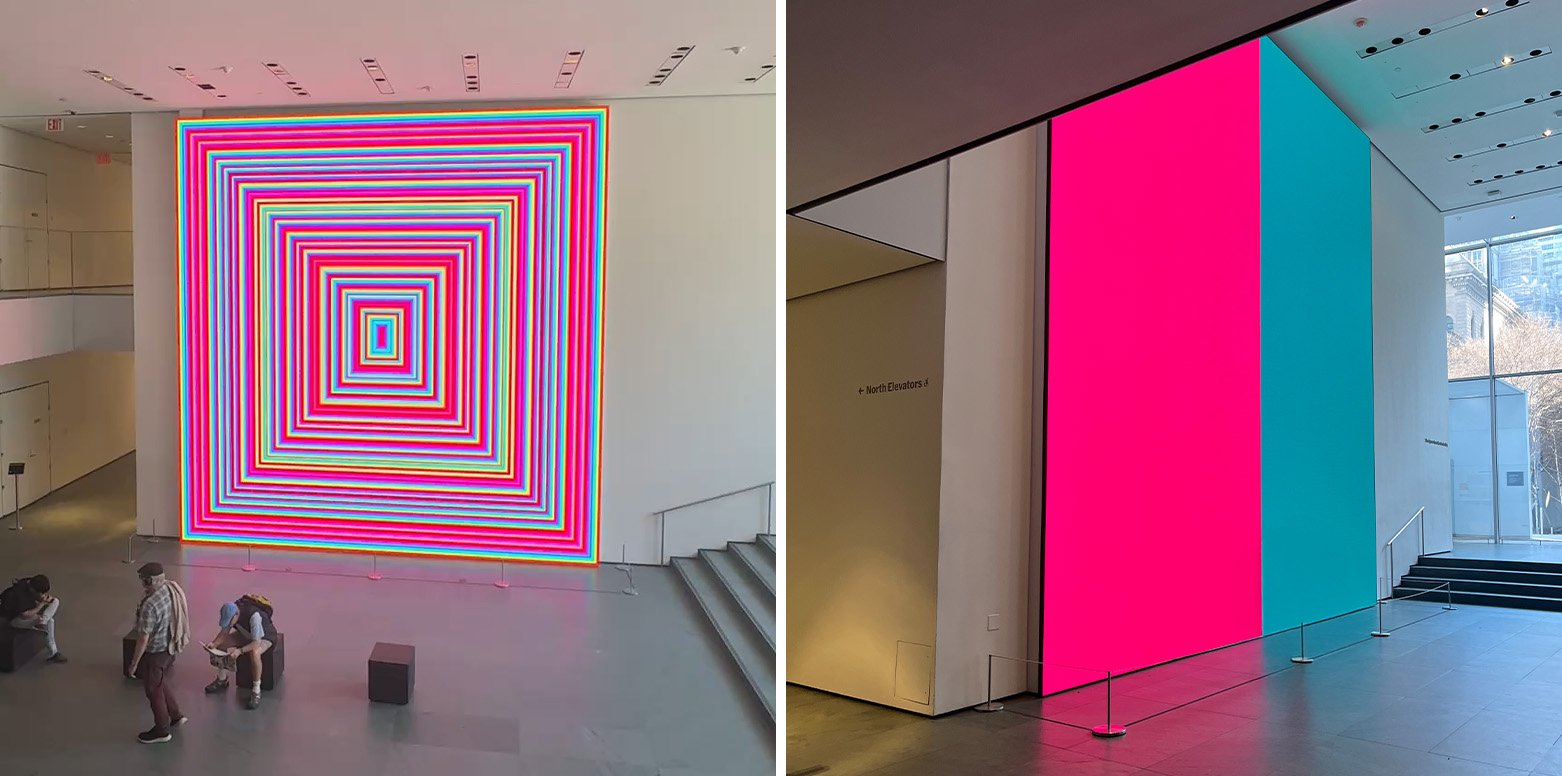
LIGHT by Rafaël Rozendaal @Hyundai Card MoMA Digital Wall
Screen, Expanded into Place
Perhaps what was most notable about Unsupervised was what came next. Contrary to expectations that the screen would be removed afterward, MoMA chose to keep it. It now serves as an ongoing exhibition platform for digital arts in the museum’s lobby.
Currently on view is 🔗Light by Dutch-Brazilian artist Rafaël Rozendaal. The exhibition title evokes both ‘luminosity’ and ‘lightweight,’ reflecting the artist’s decades-long commitment to mobility, simplicity, and code-based abstraction. “My laptop is my studio,” he once said. Most of his works are under 10KB in size. In this show, 25 pieces, totaling just 135KB, unfold across the massive screen. In this space, ultralight code meets monumental scale, and the glowing field becomes a stage for audience’s movement, producing a rhythm of its own. Here, the screen is no longer simply a visual surface. It becomes a spatial instrument: it hosts viewers, reorganizes attention, and expands sensory possibility. It transforms the museum experience into something more fluid, more communal, more dynamic.
Toward New Rhythms
What has been introduced here is but a fragment. The screen, as both medium and site, continues to invite aesthetic inquiry, layered experimentation, and cross-temporal engagement. And with it come rhythms of the audience perception and presence, formed not only by images but also by the bodies that gather, hesitate, and dwell before the screen. These rhythms will continue to surprise us.



Screen, City, and the Rhythm of the Audience
by L. J. KIM, Director at d'strict
Urban screens have evolved into media environments that embed unfamiliar temporalities into the everyday and compose new rhythms in our lives. The vision of a ‘traveling metropolis,’ an imagined future of mobile urbanism, proposed in 🔗Archigram’s Instant City project of the 1960s and ’70s has become reality in many ways. From Times Square in New York to Piccadilly Circus in London, and Samseong Station in Seoul, the screen has become more than a transmitter of visual content. It now orchestrates flows of perception, generating sensorial rhythms through the gathering and movement of people at the heart of the city.
WAVE by d'strict
Urban Screen, Inhabited by Art
This expanded screen has offered fertile ground for creative inquiry. Since the early 2000s, artists and collectives have continuously reimagined screens not as passive commercial surfaces but as potential public art platforms. Projects ranging from open-source laser graffiti to architectural-scale LED installations have opened new modes of engagement with urban media.
In 2006, Graffiti Research Lab’s 🔗L.A.S.E.R Tag projected ephemeral drawings across cities in the United States using open-source technology. In 2008, Medialab Prado in Madrid unveiled a 14.5-by-9.4-meter 🔗 LED media façade dedicated specifically to artistic use. Since 2012, 🔗Midnight Moment has illuminated more than 90 screens in New York’s Times Square each night, from 11:57 pm to midnight. In 2020, 🔗CIRCA launched as a global art platform, expanding this model to major cities through iconic digital billboards, beginning with London’s Piccadilly Circus. That same year, d’strict’s 🔗 Wave garnered global attention by reimagining a commercial media screen as immersive public art. These examples signal a continuing evolution in how the screen is inhabited, reimagined, and redefined.
Unsupervised by Epik Anadol @MoMA
Screen, Enters the Museum
The screen has also entered institutional space, suggesting another vector of expansion. A pivotal example is 🔗Unsupervised by Refik Anadol, presented at The Museum of Modern Art (MoMA) in New York in 2022. Generated by an AI trained on more than 200 years of MoMA’s collection data and integrated with real-time, site-specific input, the work functions as an evolving, immersive installation. The result is a high-resolution screen, measuring 7.21 by 7.44 meters, that dominates the museum’s main lobby both visually and spatially. Beyond its technical feat, Unsupervised drew attention both from general audiences and from members of the established art community, raising questions about the place of digital media within the canon. Visitors danced, shifted their posture, and gathered in groups, as documented on 🔗 Anadol’s Instagram. Such spontaneous engagement was rarely observed before in exhibitions of painting or sculpture. The work demonstrated that the screen functions not merely as a display but as a spatial interface: a sensorial field that generates rhythm and reciprocal presence between art and audience.
LIGHT by Rafaël Rozendaal @Hyundai Card MoMA Digital Wall
Screen, Expanded into Place
Perhaps what was most notable about Unsupervised was what came next. Contrary to expectations that the screen would be removed afterward, MoMA chose to keep it. It now serves as an ongoing exhibition platform for digital arts in the museum’s lobby.
Currently on view is 🔗Light by Dutch-Brazilian artist Rafaël Rozendaal. The exhibition title evokes both ‘luminosity’ and ‘lightweight,’ reflecting the artist’s decades-long commitment to mobility, simplicity, and code-based abstraction. “My laptop is my studio,” he once said. Most of his works are under 10KB in size. In this show, 25 pieces, totaling just 135KB, unfold across the massive screen. In this space, ultralight code meets monumental scale, and the glowing field becomes a stage for audience’s movement, producing a rhythm of its own. Here, the screen is no longer simply a visual surface. It becomes a spatial instrument: it hosts viewers, reorganizes attention, and expands sensory possibility. It transforms the museum experience into something more fluid, more communal, more dynamic.
Toward New Rhythms
What has been introduced here is but a fragment. The screen, as both medium and site, continues to invite aesthetic inquiry, layered experimentation, and cross-temporal engagement. And with it come rhythms of the audience perception and presence, formed not only by images but also by the bodies that gather, hesitate, and dwell before the screen. These rhythms will continue to surprise us.