The Significance of Presenting LED.ART in Regional Cities
by Interview with Kotomi Okawa @Kanban Keiei, April 2026
The Significance of Presenting LED.ART in Regional Cities
The Ultimate Objective: Revitalizing Tokushima Prefecture
by Interview with Kotomi Okawa @Kanban Keiei, April 2026
Ahead of the full-scale operation of the “Large LED Vision at the Tokushima Prefectural Government,” this magazine conducted an exclusive interview with the Governor’s Strategy Bureau, followed by an interview with Kotomi Okawa of Nankai Planner, who oversaw the design and construction.
We discussed the factors behind their selection, the rationale for proposing LED.ART, and the significance of its official screening—marking the first subscription-based deployment in western Japan.
Looking back, how do you assess the reasons your company was selected in the public proposal for the Tokushima LED Vision installation project?
While this is a personal view, I believe our proposal received the highest evaluation because it went beyond a simple presentation of hardware.
In addition to the LED installation itself, we incorporated the introduction of NHK’s emergency broadcasting system in preparation for a potential Nankai Trough earthquake, as well as the screening of LED.ART as a mechanism to attract public attention on a daily basis.
This, I believe, made it easier for the prefectural authorities to envision how the system would be utilized after installation.
Going forward, it will be necessary not only to provide LED displays, but to propose digital signage as an integrated package capable of generating measurable impact after deployment.
From this perspective, we recognize LED.ART as a highly effective component in proposals that take post-installation use into account.
Why is LED.ART considered effective?
This applies broadly to signage and advertising: digital signage only has value when it is actually seen by people.
Simply displaying the intended information is not sufficient to capture attention.
In particular, for newly installed LED displays, it is essential first to establish awareness of their presence—by creating content that prompts people to turn their heads, pause, and even share it on social media.
In this project, the system was also designed with information dissemination in mind for a potential Nankai Trough earthquake. Accordingly, there is an underlying objective to cultivate a habit of regularly noticing the LED display, so that in an emergency it can serve as a reliable source of information for as many people as possible.
To establish the perception of the display as something people naturally notice, LED.ART—with its highly original visuals and distinctive use of color that draws viewers in—is regarded as an optimal content solution.
This marks the first official screening of LED.ART in western Japan. What significance does this hold?
We are simply very pleased. Tokushima began operating regular flights to Incheon International Airport in December 2024, and the number of young people and women traveling abroad, particularly to Korea, has been increasing. At Incheon International Airport, LED.ART is already being presented in a dynamic format. Bringing the same content to Tokushima carries considerable significance. If someone returns from overseas and says, “This is the same art I saw at Incheon Airport,” that would be particularly meaningful.
To be candid, Tokushima is a regional city, often perceived as rural (laughs). Initially, we assumed that cutting-edge content such as LED.ART would be better suited to major urban centers. However, when presented in a regional context, it stands out in a positive way. People naturally become curious—“What is this?”—and attention gathers organically. We look forward to the day when more people see it, it becomes a topic of conversation, and spreads further.
Through the power of LED.ART, we hope to encourage wider adoption of digital signage in Tokushima and ultimately contribute, even in a small way, to the revitalization of the prefecture.
About LED.ART
LED.ART is a digital art platform developed by d’strict and CJ Group in South Korea. It is widely recognized for its ability to maximize the visual impact of LED displays.
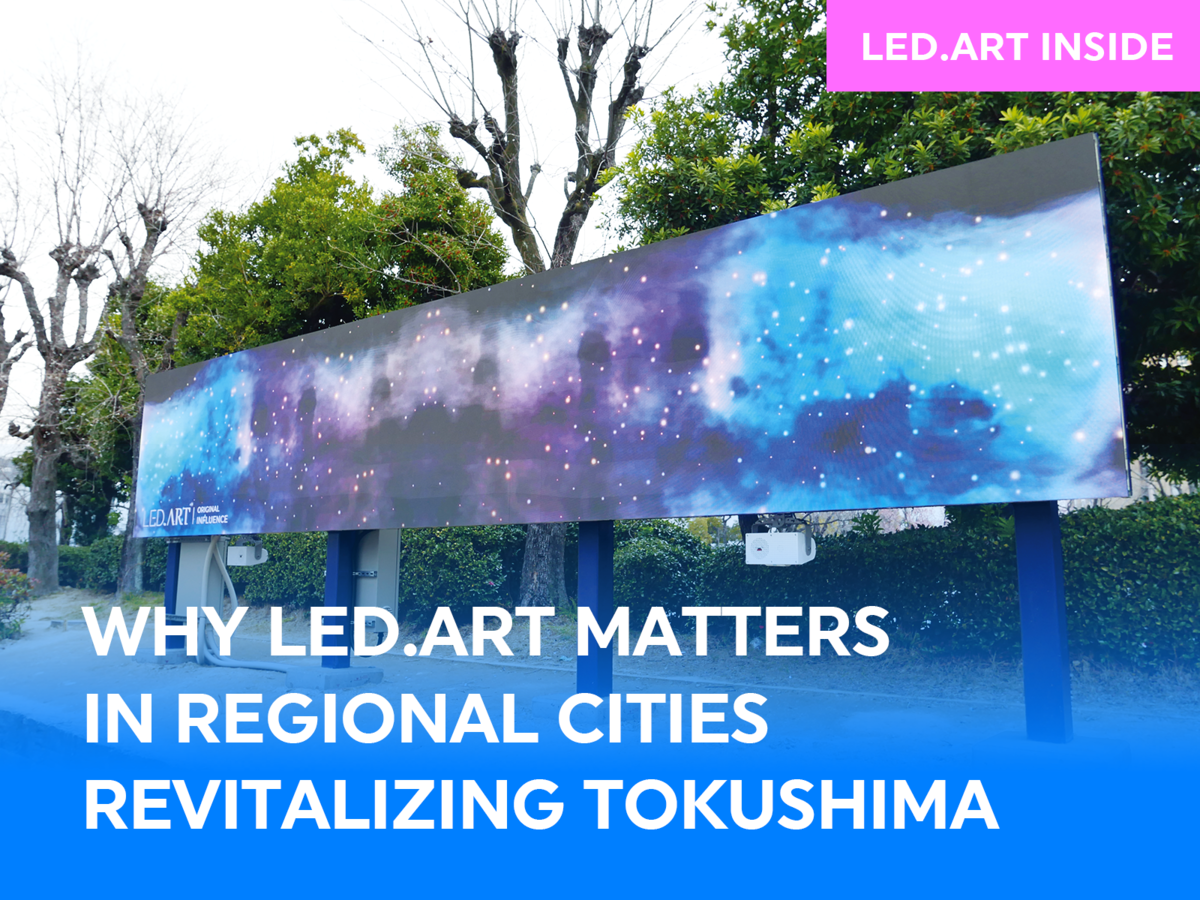
The work featured in this project, INFLUENCE, represents the invisible influence of human presence through multicolored smoke and shimmering particles.



The Significance of Presenting LED.ART in Regional Cities
The Ultimate Objective: Revitalizing Tokushima Prefecture
by Interview with Kotomi Okawa @Kanban Keiei, April 2026
Ahead of the full-scale operation of the “Large LED Vision at the Tokushima Prefectural Government,” this magazine conducted an exclusive interview with the Governor’s Strategy Bureau, followed by an interview with Kotomi Okawa of Nankai Planner, who oversaw the design and construction.
We discussed the factors behind their selection, the rationale for proposing LED.ART, and the significance of its official screening—marking the first subscription-based deployment in western Japan.
Looking back, how do you assess the reasons your company was selected in the public proposal for the Tokushima LED Vision installation project?
While this is a personal view, I believe our proposal received the highest evaluation because it went beyond a simple presentation of hardware.
In addition to the LED installation itself, we incorporated the introduction of NHK’s emergency broadcasting system in preparation for a potential Nankai Trough earthquake, as well as the screening of LED.ART as a mechanism to attract public attention on a daily basis.
This, I believe, made it easier for the prefectural authorities to envision how the system would be utilized after installation.
Going forward, it will be necessary not only to provide LED displays, but to propose digital signage as an integrated package capable of generating measurable impact after deployment.
From this perspective, we recognize LED.ART as a highly effective component in proposals that take post-installation use into account.
Why is LED.ART considered effective?
This applies broadly to signage and advertising: digital signage only has value when it is actually seen by people.
Simply displaying the intended information is not sufficient to capture attention.
In particular, for newly installed LED displays, it is essential first to establish awareness of their presence—by creating content that prompts people to turn their heads, pause, and even share it on social media.
In this project, the system was also designed with information dissemination in mind for a potential Nankai Trough earthquake. Accordingly, there is an underlying objective to cultivate a habit of regularly noticing the LED display, so that in an emergency it can serve as a reliable source of information for as many people as possible.
To establish the perception of the display as something people naturally notice, LED.ART—with its highly original visuals and distinctive use of color that draws viewers in—is regarded as an optimal content solution.
This marks the first official screening of LED.ART in western Japan. What significance does this hold?
We are simply very pleased. Tokushima began operating regular flights to Incheon International Airport in December 2024, and the number of young people and women traveling abroad, particularly to Korea, has been increasing. At Incheon International Airport, LED.ART is already being presented in a dynamic format. Bringing the same content to Tokushima carries considerable significance. If someone returns from overseas and says, “This is the same art I saw at Incheon Airport,” that would be particularly meaningful.
To be candid, Tokushima is a regional city, often perceived as rural (laughs). Initially, we assumed that cutting-edge content such as LED.ART would be better suited to major urban centers. However, when presented in a regional context, it stands out in a positive way. People naturally become curious—“What is this?”—and attention gathers organically. We look forward to the day when more people see it, it becomes a topic of conversation, and spreads further.
Through the power of LED.ART, we hope to encourage wider adoption of digital signage in Tokushima and ultimately contribute, even in a small way, to the revitalization of the prefecture.
About LED.ART
LED.ART is a digital art platform developed by d’strict and CJ Group in South Korea. It is widely recognized for its ability to maximize the visual impact of LED displays.
The work featured in this project, INFLUENCE, represents the invisible influence of human presence through multicolored smoke and shimmering particles.