There is a moment that many visitors to premium hotels, corporate headquarters, or high-end retail spaces now recognize intuitively — the moment they realize the wall is not just a wall. A surface once reserved for stone cladding or a framed canvas now breathes, shifts, and speaks. The screen has become the room.
This is not simply a technological development. It is a fundamental rethinking of what a space is for.
HD HYUNDAI by LED.ART
From Decoration to Language
For decades, art in commercial interiors served a largely decorative function. A sculpture in the lobby. A print in the corridor. A painting behind the reception desk. These choices communicated taste, but they were largely passive — objects waiting to be noticed rather than forces shaping experience.
Digital art changes this relationship entirely. A media artwork installed in a hotel atrium does not merely fill a wall. It sets a pace, a mood, a temperature of attention. Depending on the hour, the season, or the curation intent, it can make the same physical space feel expansive or intimate, contemplative or energetic. What was once static scenery becomes an active layer of environmental communication.
Hospitality brands have been among the first to understand this. When a guest enters a lobby and encounters a slowly unfolding generative artwork — one that responds to the ambient light, that evolves over the course of a day — they are not simply looking at something beautiful. They are receiving a signal about the character of the place they have entered. The art is doing the work that architecture and materials alone cannot: it is establishing an emotional register.
CENTERFIELD by LED.ART
The Brand Dimension
The shift from decoration to brand language has significant implications for how spaces are designed and managed.
Traditional interior art is chosen once and changed rarely. It is selected for permanence and neutrality — for the capacity to coexist with the widest possible range of guests and occasions without demanding too much. Digital art, by contrast, is inherently temporal and programmable. It can be curated to align with seasons, with brand campaigns, with events, with the specific profile of a space's visitors at a given hour of the day.
This programmability is not just a technical feature. It represents a new category of spatial storytelling. A luxury retail brand that rotates its digital art collection to coincide with a new product launch is not decorating its space — it is extending its creative direction into three dimensions. A financial institution that selects media artworks emphasizing precision, clarity, and calm geometry for its executive floors is making a statement about its values as legibly as any visual identity system.
The most forward-thinking space operators are beginning to treat their digital art programming the way they treat their music or lighting design: as an always-on, intentional layer of brand expression, managed with editorial care.
WUHAN MixC by LED.ART
The Question of Curation
As this understanding matures, the role of curation has become central to the conversation.
Not all digital content is art. And not all digital art is appropriate for all spaces. The distinction between a screen that displays promotional imagery and one that presents a genuinely curated work of media art is one that audiences perceive even when they cannot articulate it. There is a quality of attention — a density of intention — that separates work made for contemplation from work made for distraction.
This is why the curation layer matters so much in premium contexts. The question is not simply which screen to install, or how large to make it. The question is what kind of visual intelligence will govern the selection of what appears on that screen — and what relationship that selection will create between the space, its identity, and the people who move through it.
Artists working in digital media today are producing work of extraordinary range: generative systems that evolve in real time, video compositions designed specifically for large-format architectural display, abstract works that operate at the boundary of motion and stillness. The challenge for space operators is not a shortage of supply. It is building the discernment to match the right work to the right context with genuine precision.
INCHEON INTERNATIONAL AIRPORT by LED.ART
What Premium Actually Means
There is a useful pressure test here. In the world of physical materials — stone, timber, textile — the difference between premium and ordinary is understood in terms of origin, craft, and exclusivity. A premium material has a provenance, a maker, a story that adds meaning to the surfaces it covers.
Digital art, at its best, carries the same weight. A work commissioned or licensed from a serious media artist carries with it a layer of meaning that generic motion graphics simply cannot replicate. The space becomes a site of genuine encounter — a place where art happens — rather than a display environment where content plays.
This distinction is beginning to matter to a new generation of high-value visitors and tenants. Studies of luxury hospitality consistently show that experiential differentiation — the feeling that a space has a point of view, that it has been assembled with care and intention — drives both preference and loyalty more effectively than any single amenity. Digital art, when curated at the level of quality and specificity that premium spaces demand, is one of the most powerful tools available for producing exactly that feeling.
The screen is no longer a screen. It is a decision about identity. And the spaces that understand this earliest will be the ones that set the standard others follow.
* LED.ART curates and licenses digital artworks by leading media artists for premium commercial spaces worldwide. Our collections are selected not for spectacle, but for the quality of attention they create.


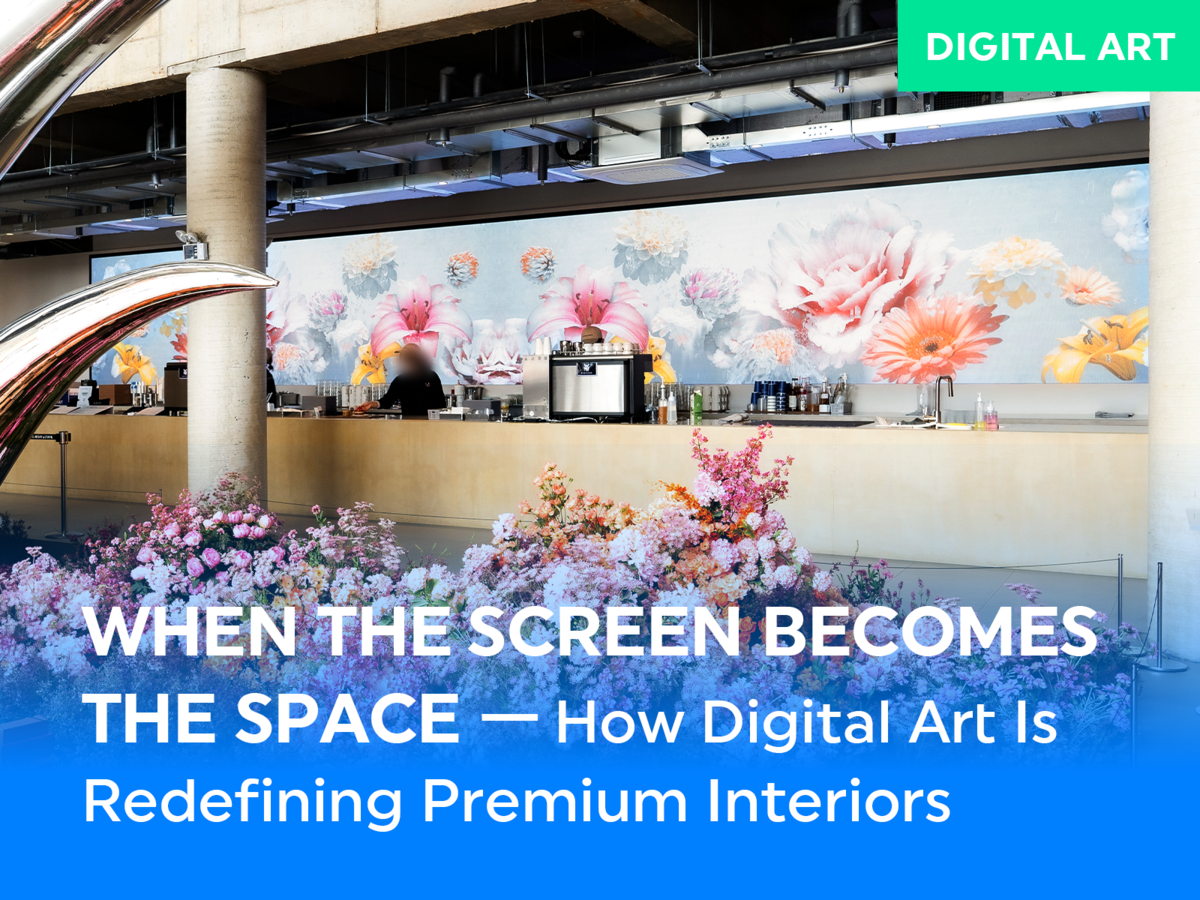

When the Screen Becomes the Space
— How Digital Art Is Redefining Premium Interiors
by LED.ART EDITORIAL
The Empire Hotel, Bangkok by LED.ART
There is a moment that many visitors to premium hotels, corporate headquarters, or high-end retail spaces now recognize intuitively — the moment they realize the wall is not just a wall. A surface once reserved for stone cladding or a framed canvas now breathes, shifts, and speaks. The screen has become the room.
This is not simply a technological development. It is a fundamental rethinking of what a space is for.
HD HYUNDAI by LED.ART
From Decoration to Language
For decades, art in commercial interiors served a largely decorative function. A sculpture in the lobby. A print in the corridor. A painting behind the reception desk. These choices communicated taste, but they were largely passive — objects waiting to be noticed rather than forces shaping experience.
Digital art changes this relationship entirely. A media artwork installed in a hotel atrium does not merely fill a wall. It sets a pace, a mood, a temperature of attention. Depending on the hour, the season, or the curation intent, it can make the same physical space feel expansive or intimate, contemplative or energetic. What was once static scenery becomes an active layer of environmental communication.
Hospitality brands have been among the first to understand this. When a guest enters a lobby and encounters a slowly unfolding generative artwork — one that responds to the ambient light, that evolves over the course of a day — they are not simply looking at something beautiful. They are receiving a signal about the character of the place they have entered. The art is doing the work that architecture and materials alone cannot: it is establishing an emotional register.
CENTERFIELD by LED.ART
The Brand Dimension
The shift from decoration to brand language has significant implications for how spaces are designed and managed.
Traditional interior art is chosen once and changed rarely. It is selected for permanence and neutrality — for the capacity to coexist with the widest possible range of guests and occasions without demanding too much. Digital art, by contrast, is inherently temporal and programmable. It can be curated to align with seasons, with brand campaigns, with events, with the specific profile of a space's visitors at a given hour of the day.
This programmability is not just a technical feature. It represents a new category of spatial storytelling. A luxury retail brand that rotates its digital art collection to coincide with a new product launch is not decorating its space — it is extending its creative direction into three dimensions. A financial institution that selects media artworks emphasizing precision, clarity, and calm geometry for its executive floors is making a statement about its values as legibly as any visual identity system.
The most forward-thinking space operators are beginning to treat their digital art programming the way they treat their music or lighting design: as an always-on, intentional layer of brand expression, managed with editorial care.
WUHAN MixC by LED.ART
The Question of Curation
As this understanding matures, the role of curation has become central to the conversation.
Not all digital content is art. And not all digital art is appropriate for all spaces. The distinction between a screen that displays promotional imagery and one that presents a genuinely curated work of media art is one that audiences perceive even when they cannot articulate it. There is a quality of attention — a density of intention — that separates work made for contemplation from work made for distraction.
This is why the curation layer matters so much in premium contexts. The question is not simply which screen to install, or how large to make it. The question is what kind of visual intelligence will govern the selection of what appears on that screen — and what relationship that selection will create between the space, its identity, and the people who move through it.
Artists working in digital media today are producing work of extraordinary range: generative systems that evolve in real time, video compositions designed specifically for large-format architectural display, abstract works that operate at the boundary of motion and stillness. The challenge for space operators is not a shortage of supply. It is building the discernment to match the right work to the right context with genuine precision.
INCHEON INTERNATIONAL AIRPORT by LED.ART
What Premium Actually Means
There is a useful pressure test here. In the world of physical materials — stone, timber, textile — the difference between premium and ordinary is understood in terms of origin, craft, and exclusivity. A premium material has a provenance, a maker, a story that adds meaning to the surfaces it covers.
Digital art, at its best, carries the same weight. A work commissioned or licensed from a serious media artist carries with it a layer of meaning that generic motion graphics simply cannot replicate. The space becomes a site of genuine encounter — a place where art happens — rather than a display environment where content plays.
This distinction is beginning to matter to a new generation of high-value visitors and tenants. Studies of luxury hospitality consistently show that experiential differentiation — the feeling that a space has a point of view, that it has been assembled with care and intention — drives both preference and loyalty more effectively than any single amenity. Digital art, when curated at the level of quality and specificity that premium spaces demand, is one of the most powerful tools available for producing exactly that feeling.
The screen is no longer a screen. It is a decision about identity. And the spaces that understand this earliest will be the ones that set the standard others follow.
* LED.ART curates and licenses digital artworks by leading media artists for premium commercial spaces worldwide. Our collections are selected not for spectacle, but for the quality of attention they create.